Malorie and Boy’s mother-son relationship
Bird BoxMalorie and Boy’s mother-son relationship is forged by care under extreme danger, but its defining contradiction is that protection requires Malorie to frighten and discipline the child she loves. She trains Boy to keep his eyes closed, heed her commands, and trust sound over sight; when they set out by river, that training proves valuable, even as Malorie sees how much of an ordinary childhood it has displaced.
A Childhood Shaped by the Rules
For four years, Boy has lived in a darkened bedroom behind coverings that block the window and beneath a chicken-wire dome. The wire once fenced a small garden beside the backyard well; repurposed as armor over the children’s beds, it protects them not from what might see them, but from what they might see. Malorie enters the room and calls, “Boy!” and “Girl!” The children wake beneath their protective structures, and Boy’s first response is “Mommy?” The familiar word belongs to a life in which even waking and opening one’s eyes have been made matters of danger and instruction.
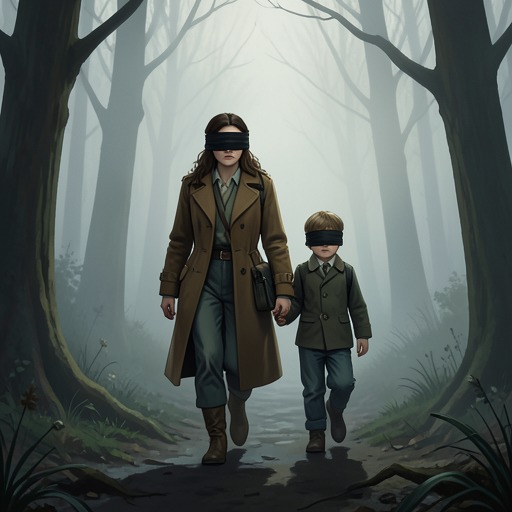
When Malorie tells the children they are going onto the river, she gives them blindfolds. Boy and Girl tie the black cloth firmly over their eyes with practiced ease. Malorie knows they should be curious about a river they have never traveled, yet they simply comply. She has not blindfolded herself yet: first she checks that the children are ready. The sequence captures their relationship in miniature. Her care is active and watchful, but the children’s safety depends on accepting her authority before they can understand the journey or its risks.
At the beginning of the escape, Malorie checks Boy’s blindfold and Girl’s, then kneels to address them at eye level. She tells them that the trip may be long and that they must do everything she says. Both answer yes. Her instruction makes obedience a practical condition of survival, not a general lesson detached from circumstance. Yet the same condition narrows the children’s freedom: on a journey into danger, their mother cannot afford to let them experiment with disobedience.
Training for Survival
Malorie’s preparation began well before the river journey. When Boy and Girl were babies, she stood over their chicken-wire beds with a flyswatter and waited for them to wake. If either opened their eyes, she struck the child’s arm; if the child kept their eyes closed, she lifted her shirt and fed them. The lesson joined protection to punishment and reward from the earliest stage of their lives. Malorie’s methods were directed toward keeping the children from looking, but the price was that ordinary waking became something they had to learn to control.
When the children were three, Malorie made Boy fetch water from the well. She tied a rope around her own waist and the other end around him, told him to feel his way along the path with his toes, and listened as he raised the bucket and struggled to carry it back. When he dropped it, she sent him out again. This was not simply an isolated task: the well was part of the household’s daily survival, and learning to negotiate the route without sight mattered. But the repeated failures and repetitions made the lesson exacting. Malorie’s protection took the form of preparing Boy to do necessary things without being able to see.
The exercises also tested the children’s sense of place through hearing. Malorie would leave the room, return, and ask where she was or where she had been. Boy and Girl had to locate her; when they were wrong, she yelled. The training placed their attention on sounds and movement, but attached the consequences of error to their mother’s judgment. In this household, learning is inseparable from discipline: Malorie teaches because the danger is real, and her insistence on correct responses is part of how she tries to keep Boy alive.
The River and the Cost of Obedience
Once underway, the rowboat repeatedly strikes the banks and becomes stuck. While Malorie wrestles with these setbacks, she imagines hands reaching for the children’s blindfolds from the water or mud. Boy does not scream or complain. When the boat needs freeing, he stands and pushes against a mossy trunk, helping Malorie get it loose so she can paddle again. His calm is useful in the immediate crisis: rather than adding panic to the difficulty, he contributes to their progress.
The journey also lets Malorie hear the world without looking at it. Birds sing in the trees, animals move through the dense woods, and fish make small splashes as they leap from the water. Boy and Malorie can register this activity by sound, while sight remains forbidden. That distinction frames their shared experience: they are not cut off from the world, but must encounter it through a channel that is safer and less complete. Boy’s learned attention helps him participate in that survival, even as the rules governing it restrict what he can freely discover.
After Malorie and the children pass a man in another boat, she reflects that he was the first living human voice the children had heard apart from one another. They did not remove their blindfolds or obey him. Malorie recognizes that she has trained them well, but cannot take uncomplicated comfort in their obedience. The thought turns discipline into a moral cost: the children’s refusal to respond to an unfamiliar voice may protect them, yet their compliance reflects fear so thoroughly instilled that they will not disobey her under any circumstances.
Malorie contrasts Boy’s childhood with her own. As a girl, she smuggled sugar into a home where it was forbidden, watched scary movies after her parents said she could not, and moved her bed into the living room when she was told not to sleep on its couch. She remembers these small acts of resistance as childhood thrills. Boy and Girl do not have the same freedom to test rules. Her comparison does not cancel the danger that makes her strict; it shows that the danger has changed the meaning of childhood itself. What Malorie remembers as harmless rebellion is precisely the sort of unsanctioned choice her children have been taught to avoid.
Care, Pain, and the Possibility of Change
During the river escape, Boy tells Malorie, “Mommy,” and says, “it worked!” He explains that his blindfold no longer hurts. The brief exchange shows how closely he tracks his mother’s instructions and how readily he brings his experience back to her for recognition. Malorie answers by telling him not to talk unless he hears something. Even this small moment of relief is brought back under the rules of the journey, where speech is useful chiefly as a response to sound that might signal danger.
Malorie feels shame and exhaustion as the trip continues. Her shoulder hurts, she is dizzy, and a deeper disorientation makes her feel that something is wrong within her. At the same time, she can hear Boy breathing in front of her and Girl handling puzzle pieces at the back of the boat. The details keep the relationship grounded in physical proximity: the children are still with her, and their ordinary sounds remain audible amid her strain. Malorie understands that they are not blind beneath their blindfolds. If she can bring them through the journey, they may reach a new world in which they can see what they have never been allowed to see.
That possibility puts the mother-son relationship at a turning point. For years, Malorie has made blindness and obedience the terms of Boy’s safety. Now she hopes to reach a place where those measures need not define his entire future. Her training has made him capable of enduring the river, and its cost remains visible in the quiet compliance she both depends on and regrets. The journey therefore tests more than whether she can protect her son in the present: it carries the hope that protection might eventually give way to a life in which Boy can look, question, and choose for himself.